
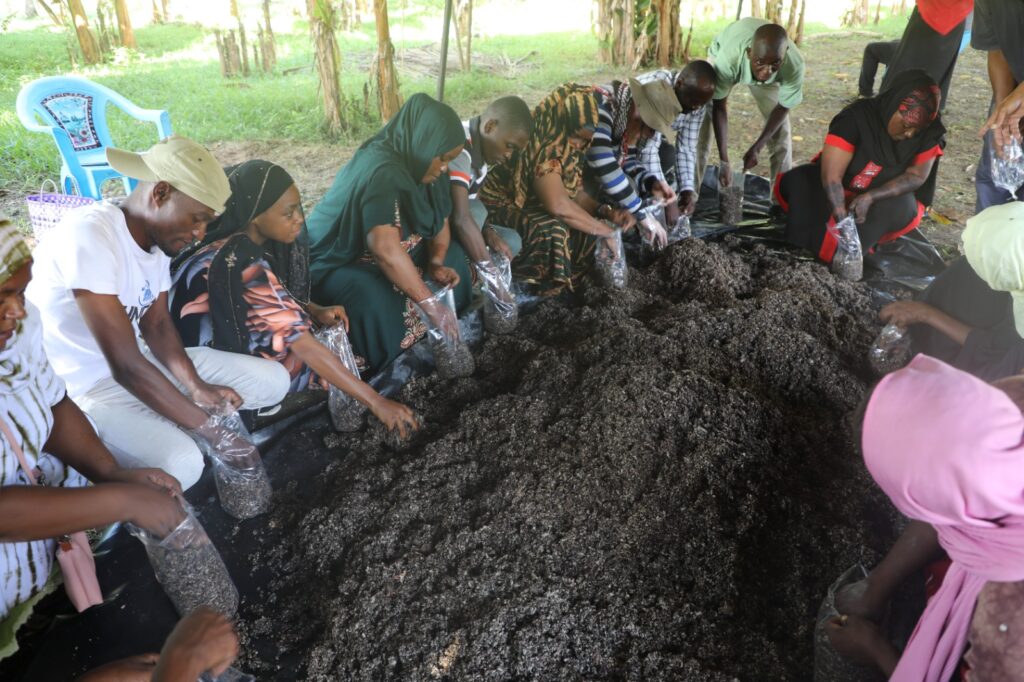
More than 30 farmers from different parts of Kwale County gathered at the homestead of retired teacher Mohammed Suleiman in Waa village for a three-day training on oyster mushroom farming organised by CRAWN Trust under the SSY project.
For many of the farmers, the training marked their first practical introduction to mushroom cultivation, a form of climate-smart agriculture increasingly being promoted as an alternative source of income in the coastal region.
Suleiman, fondly known as “Mwalimu” by his neighbours, has spent years combining farming with his teaching career. On his farm, bananas, vegetables, and passion fruits have long helped sustain his family alongside his salary and pension. However, changing weather patterns, prolonged droughts, and rising farming costs have made traditional farming less reliable in recent years.
“I had heard about mushroom farming before, but this is the first time I am learning how it is actually done,” said Suleiman during the training sessions held under the shade of coconut trees at his home.
Participants were taken through the process of oyster mushroom production, including preparation of growing materials, maintenance of controlled environments, harvesting, and marketing opportunities. The training also highlighted mushroom farming as a low-cost venture suitable for small-scale farmers facing shrinking land sizes and unpredictable rainfall.
Unlike conventional crops that depend heavily on rain and large tracts of land, oyster mushrooms can be grown indoors using agricultural waste materials such as sawdust, straw, and banana leaves. The crop matures quickly, requires little space, and can be produced throughout the year.
For many attendees, one of the biggest lessons was learning that mushrooms can thrive even in the warm coastal climate when grown under controlled conditions. Mushrooms are commonly associated with cooler regions such as Kiambu County and central Kenya, where much of the country’s production takes place.
“Considering the effects of climate change that we continue to experience in ordinary farming, I have learnt that mushroom farming can still do well because it only requires a controlled environment,” Suleiman explained.
Farmers in the county are increasingly viewing mushroom cultivation as a potential economic opportunity, especially due to the growing demand from hotels and restaurants along the coast. Tourism remains one of the major economic activities in coastal Kenya, yet many hotels in Mombasa County, Diani, and other tourist destinations still source mushrooms from other parts of the country or through imports.
“This is a promising business because the market already exists,” Suleiman said. “We have many hotels at the Coast, and they need mushrooms and mushroom products.”
Agricultural experts estimate that Kenya consumes about 1,200 tonnes of mushrooms annually, while local production stands at roughly 500 tonnes, leaving a significant supply gap that farmers could tap into.
Geoffrey Mwanyanya, a farmer from the Shimba Hills area, said the training had opened his eyes to a new farming venture that requires fewer inputs compared to conventional crop farming.
“I come from the highland areas of Kwale, where the weather is more favourable, and I see this as a good opportunity,” said Mwanyanya. “Mushroom farming does not require fertilisers or many chemicals, so it is something I want to start soon.”
Climate experts continue to warn that coastal Kenya remains highly vulnerable to climate change, with rising temperatures, erratic rainfall, soil salinity, and prolonged dry spells affecting food production and household incomes. In response, organisations such as CRAWN Trust, through initiatives like the SSY project, are promoting climate-smart agricultural practices to help communities adapt and improve livelihoods.
Beyond its economic potential, mushroom farming is also gaining attention because of its nutritional value. Participants at the training learnt that mushrooms are rich in proteins, antioxidants, fibre, vitamins, and minerals that support immunity and overall health.
“I did not know much about mushrooms before this training,” said Mwanaharusi Kombo, another participant. “Now I understand their health benefits and why they are important in our diets.”
As the sessions continued, farmers carefully examined mushroom-growing bags, exchanged ideas, and discussed how they could introduce the practice in their own communities. For Suleiman, the gathering reflected a new kind of classroom one focused not on textbooks, but on resilience, adaptation, and creating sustainable livelihoods in the face of climate change.