
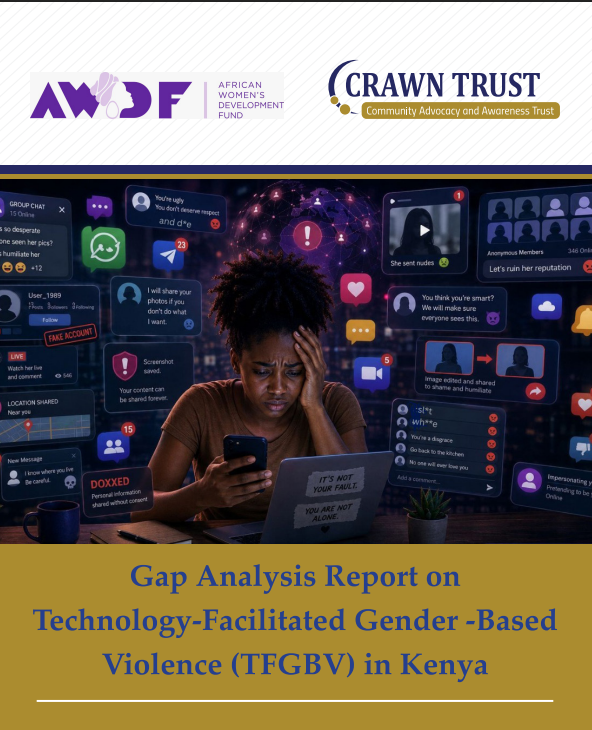
As Kenya continues to embrace digital transformation and innovation, the growing threat of Technology-Facilitated Gender-Based Violence (TFGBV) has emerged as a significant challenge to the safety, dignity, and participation of women and girls online. In response to this urgent issue, CRAWN Trust launched the Gap Analysis on Technology-Facilitated Gender-Based Violence (TFGBV) Against Girls and Women in Kenya, a landmark report developed under the Safe Spaces, Strong Voices project with support from the African Women’s Development Fund (AWDF). The launch brought together key stakeholders from government, civil society, and the digital governance sector, highlighting the collective commitment required to address digital violence. In attendance were Lana Razafimanatsoa, Program Manager at AWDF, who joined virtually via Zoom, Dr. Purity Ngina, PhD, MBS, Chief Executive Officer of the National Gender and Equality Commission, Col. Dr. James Kimuyu, Director General of the National Computer and Cybercrimes Coordination Committee (NC4), and the Chief Guest, Hon. Anne Wang’ombe, Principal Secretary, State Department for Gender and Affirmative Action. Drawing on survivor testimonies, stakeholder consultations, legal reviews, and contributions from state and non-state actors, the report reveals significant gaps in Kenya’s legal, policy, and institutional response to TFGBV. It finds that many women, including journalists, activists, students, and leaders, are withdrawing from digital spaces due to persistent online abuse, a phenomenon described as “radio silencing,” which threatens not only individual wellbeing but also democratic participation and economic development. The report identifies critical shortcomings, including the absence of a standalone legal framework on TFGBV, weak digital evidence systems, fragmented institutional responses, inadequate survivor support mechanisms, and limited regulation of emerging threats such as AI-generated deepfakes and synthetic intimate imagery. To address these challenges, the report calls for comprehensive legal reforms, stronger platform accountability, enhanced digital forensic capacity, survivor-centred support services, and urgent measures to ensure women and girls can safely participate in online spaces. Ultimately, the report emphasizes that addressing technology-facilitated gender-based violence is not only a matter of protecting rights and dignity but also a prerequisite for building a safer, more inclusive, and more prosperous digital future for Kenya.